Works from €2,500 – €3,500
Prices & availability on request.
Worldwide shipping available.
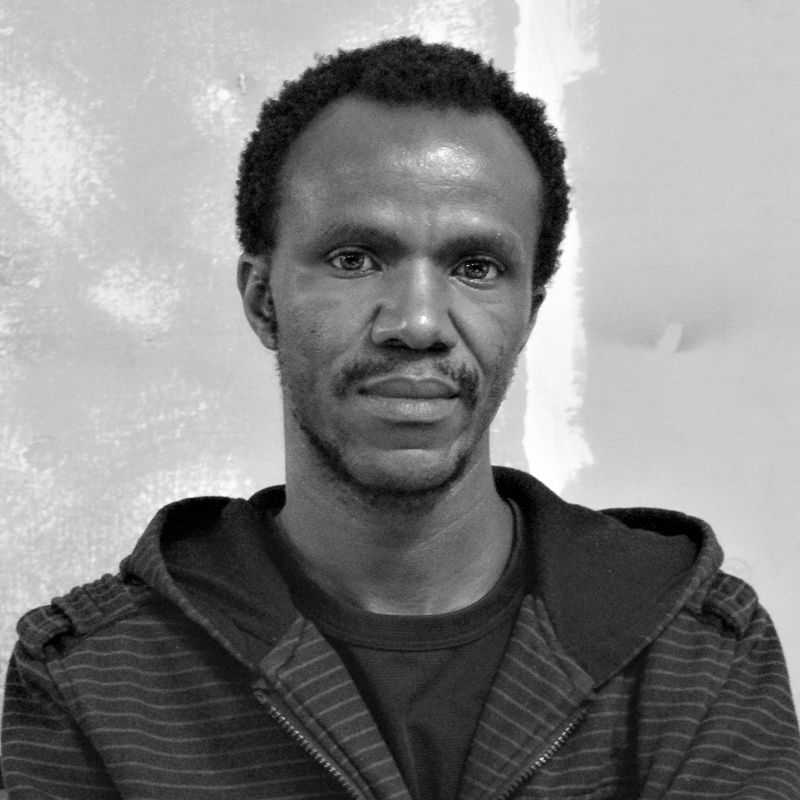
David Thuku: Kenyan Paper-Cut Painting, Empty Seats and the Politics of Space
David Thuku is a Kenyan contemporary artist born in 1985 in Nakuru, Kenya. Based in Nairobi, he is known for his distinctive works on paper, in which cutting, tearing, layering and repeated motifs become ways to examine space, absence, social position and psychological tension.
His practice belongs to a broader conversation within contemporary African art, where everyday objects can become precise tools for social and political reflection. In Thuku’s work, chairs, dice, cages, bodies, shadows and white spheres appear as signs of instability, chance, confinement and the fragile structures through which people are assigned a place.
View available works by David Thuku ›
Paper as Surface, Cut and Hidden Structure
David Thuku began his practice with painting before developing a strong attachment to paper as a material. Rather than treating paper as a neutral support, he cuts, tears and layers it, allowing the surface itself to become part of the image’s meaning.
This process reveals and conceals at the same time. Overlapping forms, exposed edges and fractured surfaces suggest that meaning is not found on a single visible plane. Thuku’s works ask the viewer to look through layers, to consider what is hidden, displaced or only partially accessible.
Empty Seats and the Question of Place
In his series Empty Seats, the chair becomes a central motif. It is present as an object of rest, authority and position, but it is rarely used in the expected way. Figures appear beside it, beneath it, above it or separated from it, creating a quiet but insistent tension.
The empty seat becomes a question: who is allowed to occupy space, who is excluded from it, who leaves, who waits, and who is forced into unstable positions? Through this simple object, Thuku opens a wider reflection on social placement, power, absence and the uncertain structures that shape daily life.
Motifs of Chance, Confinement and Unease
Thuku’s visual language is deliberately restrained. His works often use a limited palette of black, red, white and muted tones, allowing the repeated motifs to carry much of the emotional charge. Dice suggest chance and unfairness. Cages evoke confinement. Striped forms may recall barriers, shadows or imprisonment.
White spheres punctuate the pictorial space like eyes, signs, holes or threats. These motifs do not offer a single fixed interpretation. Instead, they create an atmosphere of uncertainty, inviting viewers to project their own fears, memories and questions into the work.
Nairobi, Collaboration and a Graphic Language of Introspection
After graduating from the Buruburu Institute of Fine Arts in Nairobi, David Thuku continued to live and work in the city. In 2013, he co-founded Brush-Tu Art Studio, a creative collective that provides artists with workspaces and encourages exchange, experimentation and collaboration.
His work is deeply graphic, but never merely formal. With a limited set of materials and signs, Thuku creates images that feel quiet, suspended and psychologically charged. The works do not explain themselves. They hold back, allowing silence, absence and uncertainty to become part of their force.
Selected Exhibitions, Art Fairs and Collections
David Thuku’s exhibitions with OOA Gallery include Small Is Smart, Textures, Winter Group Show 2020 and Nairobi, Here We Art.
His work has also been presented in exhibitions and art fairs including No Man’s Land at Art-Z Gallery in Paris; Paper Works and Line, The Basic Element at One Off Gallery in Nairobi; Barcode — The Layer Between at The Red Hill Gallery in Nairobi; Young Guns at Circle Gallery in Nairobi; AKAA Art Fair in Paris; Drawing Now Art Fair in Paris; 1:54 Contemporary African Art Fair in London; YIA Art Fair in Paris; Kenya Art Fair in Nairobi; and group exhibitions at the National Museum and UN Headquarters in Nairobi.
Available Works
Explore a selection of available works by David Thuku at OOA Gallery, including paper-cut works from the Empty Seats series that explore absence, social position, chance, confinement, repeated motifs and the politics of occupied space.


