About this Insight
Textile and ceramics are highly visible in contemporary art, yet both carry histories of classification that have often placed certain forms of making in a different category from painting and sculpture. In contemporary African art and diasporic practice, this matters not because textile or clay need to be “elevated” into art, but because they make visible the systems through which materials, techniques, authorship and skill are valued. This Insight asks what happens when the knowledge embedded in making becomes central to how an artwork is understood – and whether older hierarchies of media have disappeared, or simply changed form.1
This Insight draws on original written responses from Médéric Turay and Alex Rocca, alongside museum records, institutional documentation and academic research.
How Media Became Hierarchies
A textile is not intrinsically less “artistic” than a painting, nor is fired clay naturally closer to utility than to sculpture. Yet particular Western institutional and art-historical traditions built distinctions that made such comparisons seem natural. Glenn Adamson’s Thinking Through Craft is useful precisely because it does not simply rehabilitate craft as art; it examines craft through its historically perceived “second-class” relation to art, including the roles assigned to skill, materiality and learning by doing.2
Once painting and sculpture were treated as autonomous fine arts while other practices were assigned to applied, decorative or craft categories, different expectations followed. Individual authorship could be privileged over workshop production; conceptual invention separated from technical competence; objects associated with use, clothing or domestic space read differently from those presented as autonomous. These distinctions were never universal. They matter here because they shaped influential Western museum and critical structures – not because they offer a neutral vocabulary for African or diasporic making.
Textile makes this history especially visible. Elissa Auther’s study of fibre art between 1960 and 1980 examines how exhibitions and institutions positioned fibre between art and craft.3 The point is not that textile suddenly became art, but that exhibitions, critical language and institutional framing helped change how textile practices could be seen.
That history is still being reconsidered. Woven Histories: Textiles and Modern Abstraction, organised by the National Gallery of Art with LACMA, the National Gallery of Canada and MoMA, brought together around 160 works by more than fifty creators. The National Gallery explicitly presented the exhibition as a challenge to histories that had treated textiles as applied art, women’s work or domestic craft and separated them from the fine arts.1 If such distinctions still require curatorial attention, their disappearance cannot simply be assumed.
A note on “craft”
In this essay, craft is not a synonym for mass production, nor for anything made by hand. Craft, craftsmanship, artisanal production and industrial production are related but non-equivalent terms. The Victoria and Albert Museum’s account of studio pottery includes functional wares, one-off vessels and sculpture, while the Crafts Council likewise includes unique pieces within its working definition of craft.4
Uniqueness therefore does not settle the question. What matters here is not to police a boundary, but to understand the categories through which different kinds of making have been valued.
Knowledge That Lives in Making
Michael Polanyi’s idea of tacit knowledge begins from a simple premise: we can know more than we can put into words.5 In artistic practice, this means that some knowledge can be explained, while some develops through repeated work with materials – through adjustment, failure, touch and timing.
Médéric Turay describes his own process without academic vocabulary. Reflecting on technical knowledge, experimentation and the accumulation of experience, he writes:
“I often say that the mother of creation is practice, repetition and consistency.”6
For Turay, one experiment can generate the conditions for another; technical grounding matters, but so does the willingness to take risks and begin again. Repetition, in this account, is not the mechanical reproduction of a gesture but one of the ways a practice learns.
Alex Rocca approaches the same question from another direction. In written responses for this Insight, he describes his learning as “largely self-taught” and connects intuitive learning to the development of an individual language. He is clear, however, that intuition does not mean full control over the material: the material reveals possibilities but also imposes limits. As a technique becomes familiar, he deliberately tests it against new combinations and processes rather than treating technical rules as fixed.7
“It becomes a kind of dialogue between what I want to do and what the material allows me to do.”7
Rocca makes the idea of tacit knowledge more concrete. Making is not only a way to gain control; it can also reveal where control ends – where fibre, glass, ceramic or metal begins to redirect the work. Knowledge develops through that exchange rather than through the execution of a predetermined image.
This also distinguishes the present discussion from an earlier Insight Materiality and Transformation: Recycled Materials, Memory and Innovation in Contemporary African Art, which examined histories already carried by materials. The question here is different: how knowledge is produced, retained and transformed through making.
Magdalene Odundo’s Untitled #1 (1994) offers a particularly precise case. The Smithsonian’s National Museum of African Art documents the vessel as hand-coiled, scraped smooth with a gourd, coated with slips and burnished. Its orange-rust colour is not simply a pigment applied after form has been established; the museum record relates it to firing in an oxidised atmosphere in a gas kiln.8 Form, surface and colour therefore emerge from a chain of technical decisions in which material behaviour cannot be separated from the finished appearance.
Odundo’s ceramic forms depend on highly developed techniques, but those techniques are not decorative additions to a prior idea; they help produce the idea as form. Coiling controls the growth of the body, burnishing alters how the surface receives light, and firing changes colour through heat and atmosphere.
The vessel is therefore a useful test case for the hierarchy of media. It can refer to containment and use while functioning as a non-utilitarian object whose scale, silhouette and surface shape the encounter. The Smithsonian describes Odundo’s works as non-utilitarian containers of form and colour.8 The form remains legible through the history of the vessel without being reducible to use.
Odundo’s training also makes it difficult to trace this knowledge to a single origin. She moved to England in 1971 intending to pursue graphic art before turning to ceramics, later studying at West Surrey College of Art and Design and the Royal College of Art. In 1974 she worked at the Abuja Pottery Training Centre in Nigeria. Fitzwilliam Museum documentation records her account of working with Ladi Kwali, Lami Toto and Asibi Aidoo and learning a hand-building method in which the maker moves around the pot.9
Ladi Kwali’s own practice makes the history of transmission still less linear. Documentation from the Fitzwilliam Museum describes her early learning from her aunt and her continued use of coiling, while also recording wheel-throwing and glazed stoneware techniques associated with the Abuja centre. The Victoria and Albert Museum (V&A) situates that centre within the colonial context in which the British potter Michael Cardew, working for the colonial administration, established a training programme in Abuja.10
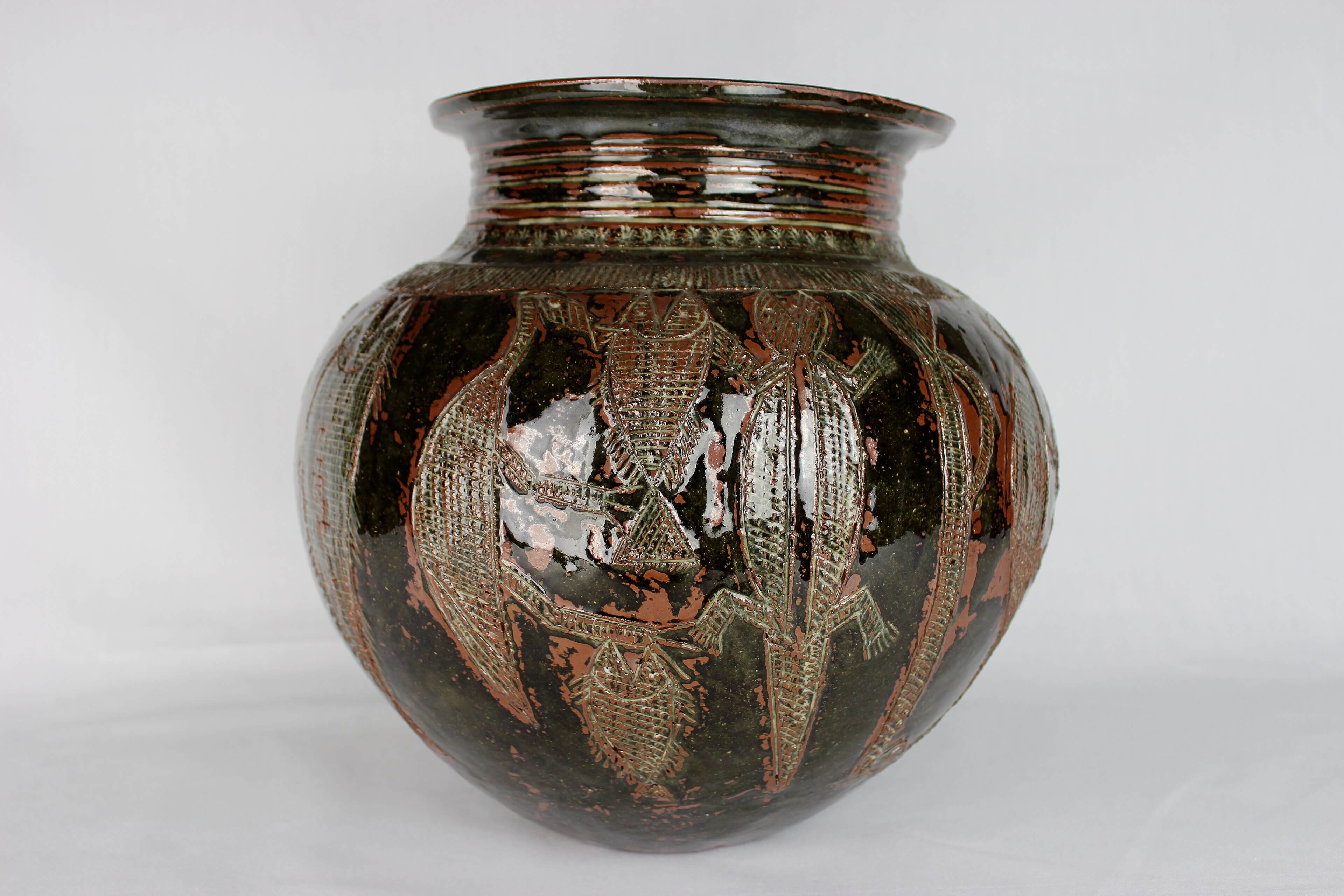
Ladi Kwali, Hand-Built Pot (YORYM 2004.1.919). Photo: York Museums Trust Staff. Courtesy of The Estate of Ladi Kwali/York Museums Trust via Wikimedia Commons. CC BY-SA 3.0.
Kwali also shows why transmission should not be romanticised as the preservation of an unchanged technique. Fitzwilliam documentation notes that a water jar still recognisable as a functional vessel could be made as an exhibition piece.10 Technique, function and audience could shift together. Rather than a simple story of “tradition meeting modernity”, what emerges is technical knowledge moving through people, institutions and unequal historical conditions – retained, modified and recombined in practice.
When a Medium Changes Form
For Turay, the move into ceramics begins not with a desire to abandon painting but with a desire to test what his recurring totemic forms can do on another support. He writes:
“Canvas and ceramics do not communicate in the same way.”6
He points specifically to the vessel’s 360-degree dimension, relief, volume and texture. That difference changes the viewer’s encounter as much as the artist’s gesture. On a canvas, the composition can be grasped frontally even when the surface is layered or physically dense. A ceramic vessel with painted and attached elements refuses a single privileged view. Its composition unfolds around a body. To see it fully, the viewer must move.
In Colors of the Silent Spirits 7 (2026), Turay combines oil, oil sticks, acrylic, burlap and copper on ceramic. The work measures 106 × 38 × 38 cm. The tall vessel presents a continuous support rather than a rectangular field. Painted marks, attached materials and changes of surface must negotiate curvature rather than a flat edge. What is visible is therefore not simply “painting on ceramics”, but a change in compositional conditions: parts of the image disappear around the form, while other elements become more prominent as the object is approached from another angle.

Médéric Turay, Colors of the Silent Spirits 7, 2026. Courtesy of the artist.
Artwork as argument. The visual point is structural rather than symbolic. The vessel’s curvature reorganises how painted marks and attached materials are encountered. No specific meaning is assigned here to an individual sign or totem beyond what Turay has documented in his own responses.
Turay’s own description is important because it prevents this formal shift from being mistaken for a categorical break. “Ceramics is not a break from my painting,” he writes.6 He describes the new works as allowing his totems to leave the canvas, take on volume and come physically closer to the visitor. The ceramic object is therefore not positioned as a replacement for painting, nor as a claim to a separate identity as a ceramic artist. It extends a pictorial practice into three dimensions.

Médéric Turay working on a ceramic piece in his studio. Photo: Abdelghani. Courtesy of the artist.
A similar instability of medium appears from a different direction in textile.
Alex Rocca describes this spatial turn as deliberate rather than incidental. “I think I’ll always approach textiles in a more sculptural, three-dimensional way,” he writes, connecting that orientation to his background in cinema and scenography and to a sustained interest in light, shadow and the body.7 His starting point is therefore not textile as a flat field that later acquires volume, but textile as a material whose structure can already be investigated sculpturally.
One example makes the distinction unusually concrete. Rocca explains that in some loom-based works he replaces the conventional flexible warp with brass wire and then weaves with ordinary yarns. When the textile is removed from the loom, the metal has already given it rigidity and sculptural form. For Rocca, that structural quality is tied to a broader investigation of corporeality across mantles, masks and other works.7
Hantu Mantle (2026) is documented in our records as cotton, natural wool, silk, viscose, bamboo fibre and ceramic. At 140 × 104 cm, it belongs materially to textile practice while incorporating ceramic into the work. Rocca’s broader current documentation likewise presents series combining fibres with glass, metal and ceramic elements.11 In his 2026 responses, he describes the Mantles as a series that began with works made entirely from textiles before expanding into glass, ceramic-textile combinations, and brass with palha da costa raffia fibre.7

Alex Rocca, Hantu Mantle, 2026. Courtesy of the artist.
That development is significant because Rocca does not describe each new material as a replacement for the previous one. Instead, an existing body of research becomes a structure within which another material can be tested. Glass, brass or ceramic enters an inquiry that already exists, and the final work develops through what he calls a negotiation between intention and material possibility.7
That spatial quality complicates the usefulness of “textile” as a purely material description. A work can remain unmistakably textile while behaving sculpturally. Calling it sculpture does not cancel the knowledge embedded in fibre; calling it textile does not confine it to the wall as surface. Rocca himself resists a hierarchy among these categories: for him, the same material can move between different fields and acquire different functions or meanings, while the research and process remain primary.7
Turay and Rocca therefore move in different directions while producing a similar blurring of boundaries. Turay carries a pictorial language onto the three-dimensional ceramic vessel; Rocca allows fibre-based practice to acquire the spatial presence of object and sculpture. In neither case does one medium simply replace another. The boundaries become less useful because the work has begun to operate across them.
This dialogue between their practices is also explored in Threads of Memory: Textile & Ceramics, which brings together Médéric Turay and Alex Rocca at OOA Gallery.
Who Makes the Work?
If the distinction between art and craft cannot be secured by material, it cannot be secured by uniqueness either. Another question then becomes unavoidable: who actually makes the work?
The presence of assistants, foundries, fabricators or specialist workshops does not automatically displace artistic authorship. Yet discussions of textile and ceramics can reactivate a simplified opposition between the “idea” of the named artist and the “skill” of the maker. That opposition undervalues both sides: it treats technical knowledge as execution without thought, while imagining artistic authorship as thought without material dependence.
Turay’s ceramic works provide a particularly clear example because he describes the division himself. The ideas and the series originate with him; a Marrakech pottery workshop helps give the forms physical shape. In his follow-up responses for this Insight, he explains that he trusts the workshop’s knowledge in decisions relating to clay and technique.12 Once the ceramic form is produced, he brings it back to his studio and develops the painted composition, symbols and totems, adding materials such as burlap, copper and textiles.6
This is neither anonymous outsourcing nor solitary making. The finished work depends on more than one kind of expertise, distributed across different stages. Turay identifies the workshop as Marwan and describes its ceramic knowledge as having been transmitted across generations. That workshop history has not been independently verified, so it remains Turay’s account of the collaboration rather than an established history of the workshop.12
The distinction matters because it changes the question from “Did the artist make it himself?” to “How are decisions, skills and responsibility distributed across the making of the work?” The answer can differ substantially from one practice to another. A specialist workshop may shape the physical conditions within which an artist works; a studio team may participate in making under sustained direction; a process may also contain knowledge that originated with collaborators rather than with the named artist. None of these structures can be understood accurately through the single opposition between individual artist and anonymous artisan.
Rocca describes a different studio structure. He currently works with one assistant for part of the day, particularly across the slow preparatory and assembly stages required by weaving and by works combining textile, glass, brass and ceramic elements. He nevertheless states that he remains directly involved in every stage of production. His reason is not simply a desire for manual control. He describes his process as empirical: preliminary drawings and ideas are starting points, while important decisions emerge as the material behaves, resists or redirects the work.7
“The work takes shape through the process of making it.”7

Alex Rocca working on a textile piece in his studio. Photo: Alex Rocca. Courtesy of the artist.
Rocca’s use of assistance therefore differs from simply delegating a fully predetermined design. He assigns tasks that facilitate production, but says he cannot simply hand over an entire piece to be executed from a fixed drawing because the work is not fully known in advance. Authorship, in this model, is tied not to performing every repetitive action alone but to remaining inside the sequence of decisions through which the work becomes what it is.7
Igshaan Adams offers another model. In a 2021 Hayward Gallery interview, Adams described his first job after art school at the Philani Child Health and Nutrition Centre in Khayelitsha. He worked with mothers whose craft production was intended to generate income, and he states that they taught him how to begin and finish a woven carpet.13 The direction of knowledge is significant: the named artist is not simply the person who transmits technique to assistants. He is also someone whose own practice was shaped by knowledge received from other makers.
This does not make Adams “self-taught”. Mudam’s 2026 documentation quotes him explaining that he deliberately avoided formal weaving training in order to operate from “not-knowing”.14 Formal training and learning are not the same thing. His Hayward interview makes clear that learning occurred through people and practice.
The same interview also complicates the word collaboration. Adams described working with a permanent group of weavers and compared the individuality of weaving to handwriting: different makers approach weave, material and technique differently, and those differences enter the work.13 He also noted that he used the term collaboration loosely in that context because some participants functioned as technicians. That distinction matters. It separates creative contribution, technical execution, artistic direction and authorship instead of treating them as the same thing.
More recent institutional documentation confirms that collaborative production remains central. For his 2026 in situ presentation at Guggenheim Museum Bilbao, new works were produced with members of his studio team and wider community in Cape Town.14 The precise structure differs from Turay’s relationship with a specialist ceramic workshop, but both practices make a similar fact visible: technical knowledge can be distributed without dissolving artistic authorship.
In the cases considered here, works made through knowledge shared among several people still circulate primarily under an individual artist’s name. Recognising specialised or collective knowledge need not weaken authorship; it can make it more precise by asking who conceived, directed, decided, learned, executed and transformed at different stages.
A smaller institutional example sharpens the point. The Metropolitan Museum of Art’s record for Andile Dyalvane’s Sandi Conical Vase (2020) identifies Dyalvane as artist and Imiso Studio as manufactory. The same record classifies the work as “Ceramics” while assigning it to the Department of Modern and Contemporary Art.15 Those metadata do not explain who performed each stage of fabrication, and they should not be used to infer a division of labour that the record does not describe. But they do show that artist, manufactory, medium and contemporary-art status can coexist within a single institutional description.
Unique does not mean made alone
A unique artwork can depend on knowledge held by several people. A handmade object can be produced repeatedly. An artist can remain the author of a work while specialist fabrication, studio labour or collaborative making forms part of its production. The relevant question is not whether more than one pair of hands was involved, but how conception, decision-making, technical knowledge and credit are distributed.
Collaboration therefore names no single production model. The more precise question is where authorship resides when conception, direction, skill and execution are distributed differently among several people.
What Institutions Reclassify
A museum does not change an object’s physical composition. It changes the framework in which the object is encountered: department, neighbouring works, label, catalogue and art-historical narrative.
Woven Histories makes that shift explicit. By placing weaving and related techniques in sustained dialogue with modern abstraction, the exhibition did more than affirm textile as art; it widened the history through which abstraction itself could be understood.1
Ceramics has been approached in similar ways. Yale University Press described The Ceramic Presence in Modern Art as responding to ceramics’ position at the margins of dominant narratives of modern art by presenting later twentieth-century ceramics alongside contemporaneous work in other media.1 The object remains the same; the historical relationships around it change.
The same Met record shows this overlap in a particularly concise way: “Ceramics” remains the classification while “Modern and Contemporary Art” names the curatorial department.15 The categories have not vanished; they occupy the same institutional record.
This is related to, but distinct from, the question examined in an earlier Insight How Museums Are Rewriting the Canon: Contemporary African Art in European Institutions. That essay asked how artists and histories enter or alter the museum canon. Here the question is narrower: what happens when the categories through which media themselves have been organised are reconsidered?
Museum inclusion does not mean the debate is settled. A textile or ceramic work entering a modern or contemporary collection does not change the status of every maker, workshop or object using related techniques. Institutional recognition is evidence of changing frameworks, not proof that older hierarchies have disappeared.
Has the Hierarchy Disappeared – or Changed Form?
The increased visibility of textile and ceramics in contemporary-art institutions does not prove that older hierarchies have disappeared. What the examples considered here show more clearly is that their boundaries have become harder to sustain.
A textile work can behave as sculpture without ceasing to depend on fibre knowledge. A ceramic vessel can remain legible as a vessel while circulating through a modern and contemporary art department. A unique work can depend on specialist or collective knowledge without losing artistic authorship.
Skill without reduction
Renewed attention to technique can correct an older tendency to separate manual skill from artistic thought. But skill becomes another form of reduction if virtuosity is allowed to stand in for the work’s ideas or formal qualities. To value technique seriously is not to make technique the explanation for the art.
Authorship without a single production model
Turay, Rocca and Adams reveal three different distributions of knowledge: a specialist ceramic workshop, studio assistance within an empirical process, and a larger weaving structure in which knowledge circulates among makers. “Collaboration” is therefore too broad a word unless the structure behind it is described.
Categories that constrain – and preserve histories
Terms such as textile art and ceramic art can reproduce separations that contemporary practice crosses, yet abandoning them altogether can also obscure technical histories and communities of practice. Rocca acknowledges that distinctions between craft, design and contemporary art affect how work is perceived, but rejects a hierarchy among them: “I don’t believe that one of these categories is necessarily superior to another.”7
Turay arrives at a related position from within his own practice:
“For me, these categories are not really separate. They can all come together in a single work.”6
Neither statement removes the categories. Both show that they can overlap. Textile and ceramics show how unstable inherited boundaries become once making, technical knowledge, collaboration and institutional classification are considered together. Technical knowledge can be conceptual; repetition can be investigative; an inherited method can be transformed; a collaborative process can still produce a singular work.
In that sense, the knowledge of making is not supplementary to contemporary art. It is one of the places in which contemporary art thinks.
Acknowledgements
We would like to thank Médéric Turay and Alex Rocca for contributing written responses to the research for this Insight, and Turay for providing additional follow-up clarifications on his ceramic process.
Methodology and attribution
This curatorial essay draws on original written responses from Médéric Turay and Alex Rocca, published artist interviews, artist and gallery documentation, museum collection records, exhibition documentation and academic research. Turay responded in French on 10 and 13 September 2026; Rocca responded directly in English on 18 September 2026 to questions sent in Brazilian Portuguese. Published and institutional sources are used to establish the historical framework and to distinguish documented processes from artists’ own accounts and from the curatorial interpretation developed here.
Artist statements describe what an artist says about an intention, process or experience. Documented facts are established through institutional, academic or primary documentation. The curatorial readings in this essay identify what the essay interprets in the relationship between form, technique and context. No cultural or symbolic meaning is assigned to a material or motif without sufficient documentation.
Editorial Note
This Insight is based in part on written responses received from Médéric Turay on 10 and 13 September 2026 and from Alex Rocca on 18 September 2026. Turay’s responses were provided in French; the English translations of the quotations used in this article were prepared by Michel de Jong Vázquez and confirmed by the artist on 20 September 2026. Rocca answered directly in English, following questions sent in Brazilian Portuguese; the direct quotations selected for publication were confirmed by the artist on 19 September 2026.
Rocca did not provide a separate response elaborating, in his own words, on the specific Afro-Brazilian, Bantu or Yoruba references raised in the research questions. His artist biography on this website, which was reviewed and approved by the artist, situates his practice in relation to Bantu, Yoruba and Afro-Brazilian cosmologies. In his written responses for this Insight, Rocca more broadly describes his material research as connected to Afro-diasporic histories and practices. The present article does not develop these references further because they fall outside its primary argument.
Magdalene Odundo, Ladi Kwali, Igshaan Adams and Andile Dyalvane did not contribute directly to this article. Their practices are discussed through museum records, institutional publications, published artist interviews and exhibition documentation. The article distinguishes documented facts from the curatorial readings developed here and does not attribute undocumented intentions to these artists.
Artwork metadata for Médéric Turay and Alex Rocca is drawn from our records. Image permissions and reproduction credits for non-OOA works are handled separately from the documentary basis of the text. For Magdalene Odundo’s Untitled #1, the current publication plan is to link to the Smithsonian collection record rather than reproduce the image.
September 2026 – An OOA Gallery Editorial
Research and text by Michel de Jong Vázquez
Notes and Sources
-
National Gallery of Art, “Woven Histories: Textiles and Modern Abstraction,” exhibition page (17 March–28 July 2024); Lynne Cooke, ed., Woven Histories: Textiles and Modern Abstraction (Washington, DC: National Gallery of Art; Chicago: University of Chicago Press, 2023); and Sequoia Miller, “The Ceramic Presence in Modern Art,” Yale University Press, 2 February 2016. Exhibition; publication; Yale University Press. Accessed 21 September 2026.
Source note: Together these sources document the historically marginal positioning of textiles and ceramics within influential Western modern-art narratives. The National Gallery sources support the discussion of Woven Histories, including its challenge to hierarchies separating textiles from the fine arts; the Yale source supports the parallel discussion of ceramics. They do not establish a universal hierarchy across cultures or historical periods.
-
Glenn Adamson, Thinking Through Craft (Oxford/New York: Berg, 2007). Bloomsbury. Accessed 16 September 2026.
Source note: Provides the conceptual framework for craft’s historically perceived “second-class” relation to art and for discussions of skill and learning by doing. Adamson’s analysis belongs to modern Western craft/art discourse and is not a history of African material practices.
-
Elissa Auther, “Fiber Art and the Hierarchy of Art and Craft, 1960–80,” The Journal of Modern Craft 1, no. 1 (2008): 13–33, https://doi.org/10.2752/174967708783389896. Article record. Accessed 16 September 2026.
Source note: Documents artistic, institutional and curatorial forces shaping fibre art in the 1960s and 1970s and analyses strategies used to negotiate the hierarchy between art and craft. Its historical scope is primarily US/Western and should not be universalised.
-
Victoria and Albert Museum, “Studio Pottery: an introduction,” 27 June 2025; Crafts Council, Market for Craft, 2020, “Definitions of terms.” V&A; Crafts Council. Accessed 16 September 2026.
Source note: Supports the distinction between craft and industrial serial production: studio pottery can include one-off vessels and sculpture, and the Crafts Council definition explicitly includes stand-alone unique pieces. These are contemporary UK institutional definitions rather than universal definitions of craft.
-
Michael Polanyi, The Tacit Dimension, with a foreword by Amartya Sen (Chicago: University of Chicago Press, 2009; first published 1966). University of Chicago Press. Accessed 16 September 2026.
Source note: Establishes the general concept that human knowledge can exceed what can be fully articulated in words. Polanyi does not write specifically about textile, ceramics or contemporary African art; applying the concept to making is part of the curatorial framework used in this essay.
-
Médéric Turay, written responses to Michel de Jong Vázquez for OOA Gallery, 10 September 2026. Unpublished primary source held in the OOA Gallery editorial research file.
Source note: Establishes Turay’s own statements on repetition and constancy, the difference he perceives between canvas and ceramic volume, the 360-degree encounter with his vases, his view that ceramic is a continuation rather than a rupture with painting, and his position that categories such as craft, design and sculpture need not be separate. The English translations of the quotations used in this article were confirmed by Turay on 20 September 2026. It does not independently verify external historical claims.
-
Alex Rocca, written responses to Michel de Jong Vázquez for OOA Gallery, 18 September 2026, unpublished primary source held in the OOA Gallery editorial research file; and OOA Gallery, “Alex Rocca – Biography,” artist biography reviewed and approved by the artist, accessed September 2026. Artist biography.
Source note: Establishes Rocca’s current account of his largely self-taught approach to textile techniques; his emphasis on gesture, intuitive learning and material limits; his deliberately sculptural treatment of textiles; the evolution of the Mantles series across textile, glass, ceramics, brass and palha da costa; his view that craft, design and contemporary art are not hierarchically ordered within his practice; and his current studio process, in which one assistant supports production while Rocca remains directly involved in every stage and retains responsibility for decisions essential to the work’s development. The direct quotations selected for publication were confirmed by Rocca on 19 September 2026. Rocca also describes his material research more broadly as connected to Afro-diasporic histories and practices. The specific Afro-Brazilian, Bantu and Yoruba references are documented in his artist-approved biography published on this website but are not elaborated in the 18 September 2026 primary response.
-
National Museum of African Art, Smithsonian Institution, collection record for Magdalene Anyango N. Odundo, Untitled #1, 1994, object no. 95-8-1. Collection record. Accessed 16 September 2026.
Source note: Establishes the work’s date, medium and dimensions and documents the making process: hand-coiling, smoothing with a gourd, slips, burnishing and the dependence of colour on firing technique. The record specifically notes that the orange-rust colour is achieved in an oxidised gas-kiln atmosphere.
-
Fitzwilliam Museum, “Magdalene Odundo” and “Labels for case 5,” Magdalene Odundo in Cambridge; Royal College of Art, “Celebrating RCA Alumnae for Black History Month 2019.” Fitzwilliam Museum; case documentation; Royal College of Art. Accessed 16 September 2026.
Source note: Establishes the more precise chronology of Odundo’s move to England in 1971 intending to pursue graphic art, her subsequent ceramics training and her 1974 period at the Abuja Pottery Training Centre. The Fitzwilliam also records Odundo’s direct account of learning hand-building while working with Ladi Kwali, Lami Toto and Asibi Aidoo.
-
Fitzwilliam Museum, “Magdalene Odundo Audio: Memories of Nigeria” and learning/collection documentation for Ladi Kwali; Victoria and Albert Museum, “Studio Pottery: an introduction.” Fitzwilliam Museum; V&A. Accessed 16 September 2026.
Source note: Establishes that Kwali learned local pot-making methods from her aunt, continued to work primarily through coiling and learned wheel-throwing and glazed stoneware techniques after joining the Abuja Pottery Training Centre. The sources also document the centre’s colonial administrative context; they do not support a simple binary of “African tradition” versus “Western modernity.”
-
Alex Rocca, official artist website, “Trabalhos,” accessed September 2026; Nathan Bahadursingh, “The Dwell 24: Alex Rocca,” Dwell, 2021. Artist website; Dwell interview. Accessed 16 September 2026.
Source note: The artist website documents current materials and series; the 2021 Dwell interview supplies historical context for Rocca’s early textile learning. Both are supplementary to the 18 September 2026 primary source and should not override his current account.
-
Médéric Turay, follow-up written responses to Michel de Jong Vázquez for OOA Gallery, 13 September 2026. Unpublished primary source held in the OOA Gallery editorial research file.
Source note: Establishes Turay’s account that the ideas and series originate with him, that the Marrakech workshop helps give the forms physical shape, and that he relies on the workshop’s technical knowledge for clay and technical choices. Turay identifies the workshop as Marwan and describes its knowledge as transmitted across generations; that genealogy remains attributed to Turay and is not independently corroborated.
-
Hayward Gallery, “Interview with Igshaan Adams,” in the large-print exhibition guide for Igshaan Adams: Kicking Dust, March 2021. Exhibition guide. Accessed 16 September 2026.
Source note: Establishes Adams’s own account of learning to start and finish woven carpets from mothers at the Philani Child Health and Nutrition Centre after graduating from art school. The same interview documents his description of individual weavers’ approaches as comparable to handwriting and complicates the use of the term collaboration. This supports learning through people and practice rather than the label “self-taught.”
-
Mudam Luxembourg, “Igshaan Adams: Between Then and Now,” 10 February–16 August 2026; Guggenheim Museum Bilbao, “The Process Behind in situ: Igshaan Adams,” 2026. Mudam; Guggenheim Bilbao. Accessed 16 September 2026.
Source note: Mudam records Adams’s statement that he deliberately avoided formal weaving training; the Guggenheim documents recent works made with members of his studio team and wider community in Cape Town. Together, the sources distinguish absence of formal training from learning in isolation and establish a contemporary collaborative production model.
-
Metropolitan Museum of Art, collection record for Andile Dyalvane, Sandi Conical Vase, 2020, object no. 2021.275. Collection record. Accessed 16 September 2026.
Source note: Establishes the simultaneous institutional metadata: Andile Dyalvane as artist, Imiso Studio as manufactory, glazed ceramic as medium, Ceramics as classification, and Modern and Contemporary Art as curatorial department. The record does not by itself explain the division of labour between Dyalvane and Imiso Studio.


